





















Now Reading: The Execution Pivot: Why 2026 is the Year Sustainability Becomes a Competitive Cost Disruptor
-
01
The Execution Pivot: Why 2026 is the Year Sustainability Becomes a Competitive Cost Disruptor
The Execution Pivot: Why 2026 is the Year Sustainability Becomes a Competitive Cost Disruptor
Introduction
For the better part of the 2020s, “Sustainability” was often relegated to the realm of CSR reports and non-binding ESG pledges. However, as we move through 2026, the luxury of “ambition” has been replaced by the necessity of “execution.” We have entered a new era where the green transition is no longer a marketing story—it is a core operating system. For leading businesses, the focus has shifted from reporting carbon footprints to fundamentally re-engineering supply chains to survive a new global regime of carbon taxation and resource scarcity.
What’s the new move?
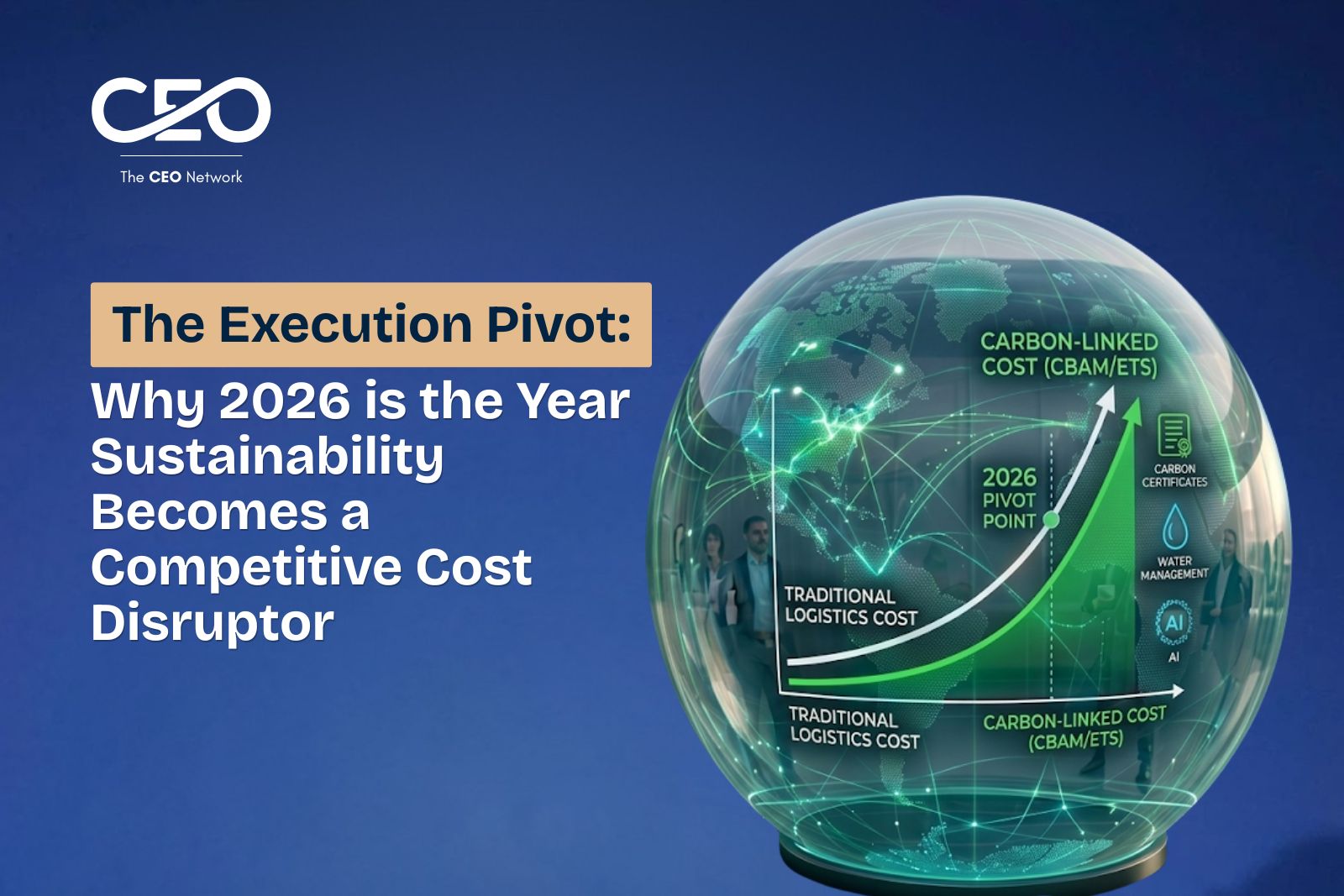
While 2025 was defined by the “Smarter Materiality” movement, 2026 is the year of Financial Impact. As of January 1, 2026, the European Union’s Carbon Border Adjustment Mechanism (CBAM) officially moved from a reporting phase to a direct financial obligation. Importers are now required to purchase and surrender certificates that reflect the embedded carbon in their goods, making “dirty” supply chains a direct hit to the bottom line.
Simultaneously, the world’s leading tech giants are facing a “Resource Reckoning.” As AI models explode in complexity, the water and energy required to cool massive data centers have hit a breaking point. Leading businesses like Microsoft, Google, and Amazon are now pioneering “Water-Neutral” computing, shifting investments toward closed-loop cooling systems and AI-enabled energy management to avoid local regulatory shutdowns in drought-prone regions.
Why the sudden acceleration? The key drivers
- Regulatory Enforcement: The phase-in of the EU ETS (Emissions Trading System) to 100% and the debut of the CBAM financial penalties have turned carbon into a tradable, high-cost commodity.
- The “AI+Human” Productivity Boom: AI is no longer a “buzzword” in 2026; it is a strategic imperative. CEOs are moving away from full automation toward “Collaborative Intelligence” models, where AI handles predictive logistics and carbon accounting, freeing human leadership to focus on empathy and high-stakes strategy.
- Capital Flight to Resilient Infrastructure: Investors are aggressively rerouting capital toward “Advanced Manufacturing” hubs. The 2026 M&A mega-cycle—headlined by the $33.4 billion acquisition of AES Corp by GIP and EQT—signals a massive bet on companies that control the infrastructure of the energy transition.
By the numbers: The economic shift
- $500 Billion: The projected global investment in Artificial Intelligence in 2026, reflecting its integration into every core business function from finance to logistics.
- 25%: The projected growth in Advanced Manufacturing this year, fueled by automation, robotics, and the rise of smart, localized supply chains.
- $1.38 Trillion: The estimated value of the FinTech market by 2034, with 2026 serving as the catalyst year for “Transition Finance” and automated ESG-linked lending.
- 3.1%: The forecast for Global GDP growth in 2026, a resilient figure despite geopolitical instability, driven largely by the digital transformation of legacy industries.
Implications for the broader ecosystem
For the C-Suite, the message of 2026 is clear: Resilience is the new Efficiency. The era of chasing the lowest-cost supplier is over; the new goal is the lowest-carbon, most-reliable supplier. Leading businesses are adopting “Modular-by-Design” principles to ensure their products stay within circular loops, decoupling their growth from the volatile costs of raw material extraction.
Furthermore, as the AI Safety Clock moves closer to a global regulatory standard, the “Leading Businesses” of 2026 are those that prioritize Cyber-Governance. With boards now taking a direct role in AI ethics and data interoperability, the CEO’s role has transformed from a top-down commander to an orchestrator of complex, tech-enabled ecosystems.