













Now Reading: The Quantum Leap: Global Business Braces for the Post-Encryption Era by 2030
-
01
The Quantum Leap: Global Business Braces for the Post-Encryption Era by 2030
The Quantum Leap: Global Business Braces for the Post-Encryption Era by 2030
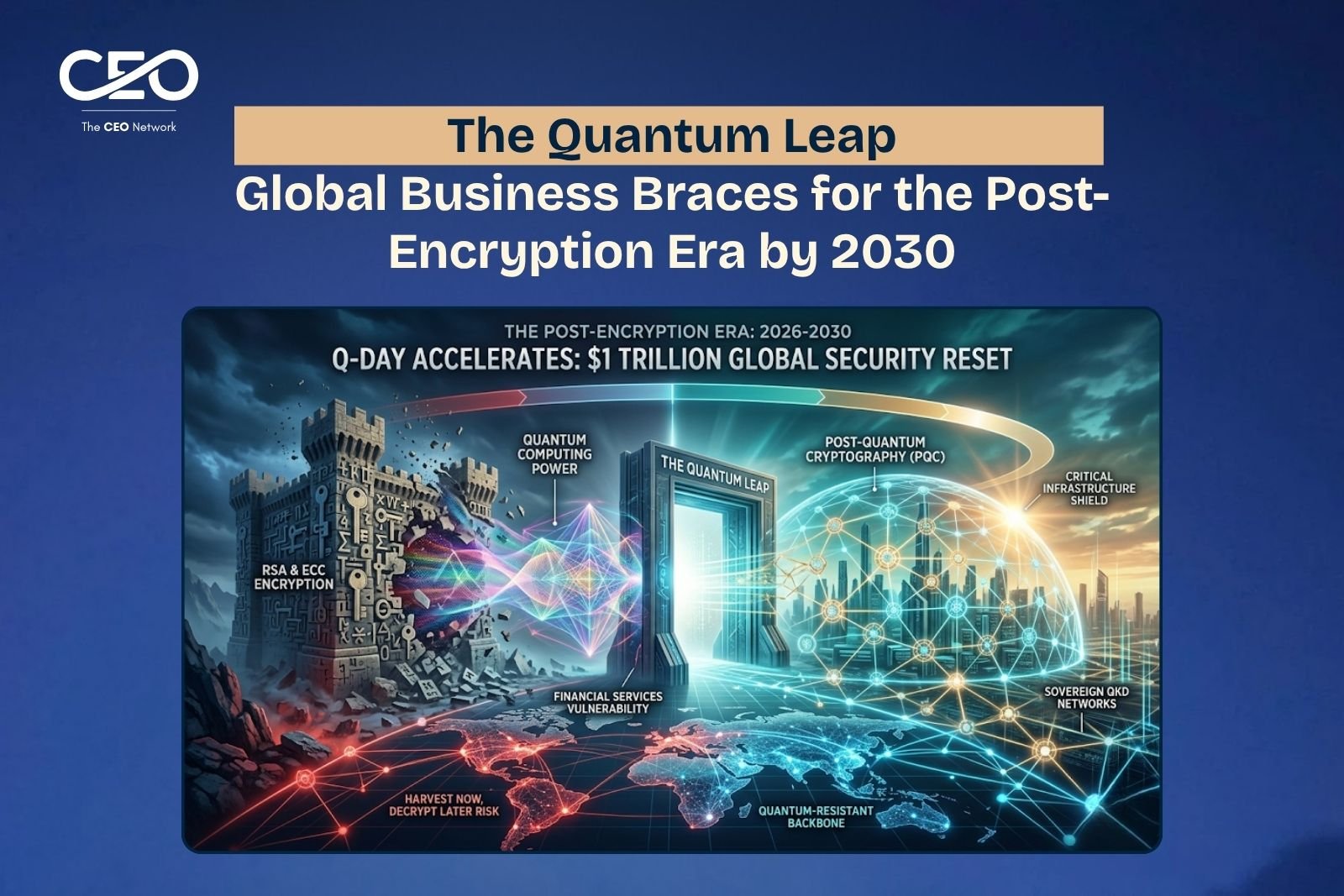
For decades, the foundation of global digital commerce has rested on RSA and ECC encryption. It is the silent guardian of every financial transaction, every confidential email, and every proprietary blueprint. But a tectonic shift is approaching, and it is imperative that the C-suite globally pays attention. The “Quantum Leap” is no longer a theoretical risk; it is an imminent operational reality that will fundamentally redefine digital security by 2030.
According to a series of urgent high-level briefings finalized in April 2026 by the Global Quantum Security Council (GQSC), the timeline for “Q-Day”—the hypothetical moment when a quantum computer scales sufficiently to break current prime-factor encryption—has accelerated.
For members of The CEO Network, this isn’t just an IT problem; it is a foundational risk management priority that demands immediate strategic intervention.
“Quantum computing will do to classical encryption what the tank did to the medieval castle wall. We are not just upgrading software; we are transitioning to a completely new physics of security.”
Why 2030 is the New Strategic Deadline
The accelerating pace of quantum development, led by IBM, Google, and Quantinuum, coupled with significant breakthroughs in error correction, has moved Q-Day from “decades away” to “likely this decade.”
The GQSC report emphasizes a critical concept: “Harvest Now, Decrypt Later” (HNDL). State-sponsored actors and sophisticated criminal syndicates are already actively harvesting vast amounts of highly sensitive, encrypted data (national security documents, long-term pharmaceutical patents, bank transaction records). They cannot read it today, but they are storing it, betting that a quantum computer will unlock it within five years.
For a CEO, this means that if your sensitive data with a 10-year lifespan is not secured with quantum-resistant methods right now, it is effectively already compromised.
The $1 Trillion Security Reset
The global business impact is staggering. Transitioning the entire world’s digital infrastructure to Post-Quantum Cryptography (PQC) and implementing Quantum Key Distribution (QKD) is estimated to cost over $1 trillion globally by 2030.
- Financial Services: The entire global SWIFT banking network and cryptocurrency ledgers are vulnerable. Banks are already beginning the multi-year process of re-keying their entire architecture.
- Critical Infrastructure: Power grids, transportation networks, and communication satellites rely on encrypted commands. A successful quantum attack could paralyze entire nations.
- Healthcare and Biopharma: Decades of patient data and proprietary genomic research are top HNDL targets.
The CEO’s Post-Quantum Playbook: 2026-2030
Wait-and-see is no longer an option. A proactive stance is required.
Immediate CEO Actions:
- Mandate a Quantum Risk Audit: By Q4 2026, every large enterprise must have identified all systems using vulnerable classical encryption, prioritized by data sensitivity and lifespan.
- Define a PQC Transition Roadmap: Establish a clear budget and timeline to implement the newly finalized NIST (National Institute of Standards and Technology) PQC algorithms. This is a multi-year IT and cryptographic migration.
- Appoint a Chief Quantum Risk Officer (CQRO): Elevate quantum risk to a standalone C-suite responsibility or a primary mandate for the CRO/CISO, with direct reporting to the board.
- Explore Hybrid Solutions: Begin implementing “hybrid” security systems that combine classical security with early PQC layers to defend against HNDL attacks.
A New Dynamic: Cooperation and Sovereignty
The race for quantum security is intensifying geopolitical competition. While the PQC algorithm standards are a result of global cooperation (primarily led by NIST), nations are simultaneously racing to build their own physical quantum communication infrastructure, particularly QKD satellite networks. China and the EU are investing heavily in these sovereign “quantum-safe” backbones.
Global CEOs must navigate this complexity, choosing security partners that are not only technologically advanced but also geopolitically aligned with their primary markets.
The Bottom Line
The approaching quantum era presents an existential threat to the digital status quo. But for visionary leaders, it also offers a defining moment. CEOs who successfully navigate this transition will not only secure their enterprise’s future but will also signal to clients and investors that their organization is built for the long-term, capable of thriving in the post-encryption world.
Is your organization ready for the Quantum Leap, or are you still relying on 20th-century shields?