





Now Reading: The Intelligence Inquest: Altman, Musk, and the Legal Blueprint for AI Governance
-
01
The Intelligence Inquest: Altman, Musk, and the Legal Blueprint for AI Governance
The Intelligence Inquest: Altman, Musk, and the Legal Blueprint for AI Governance
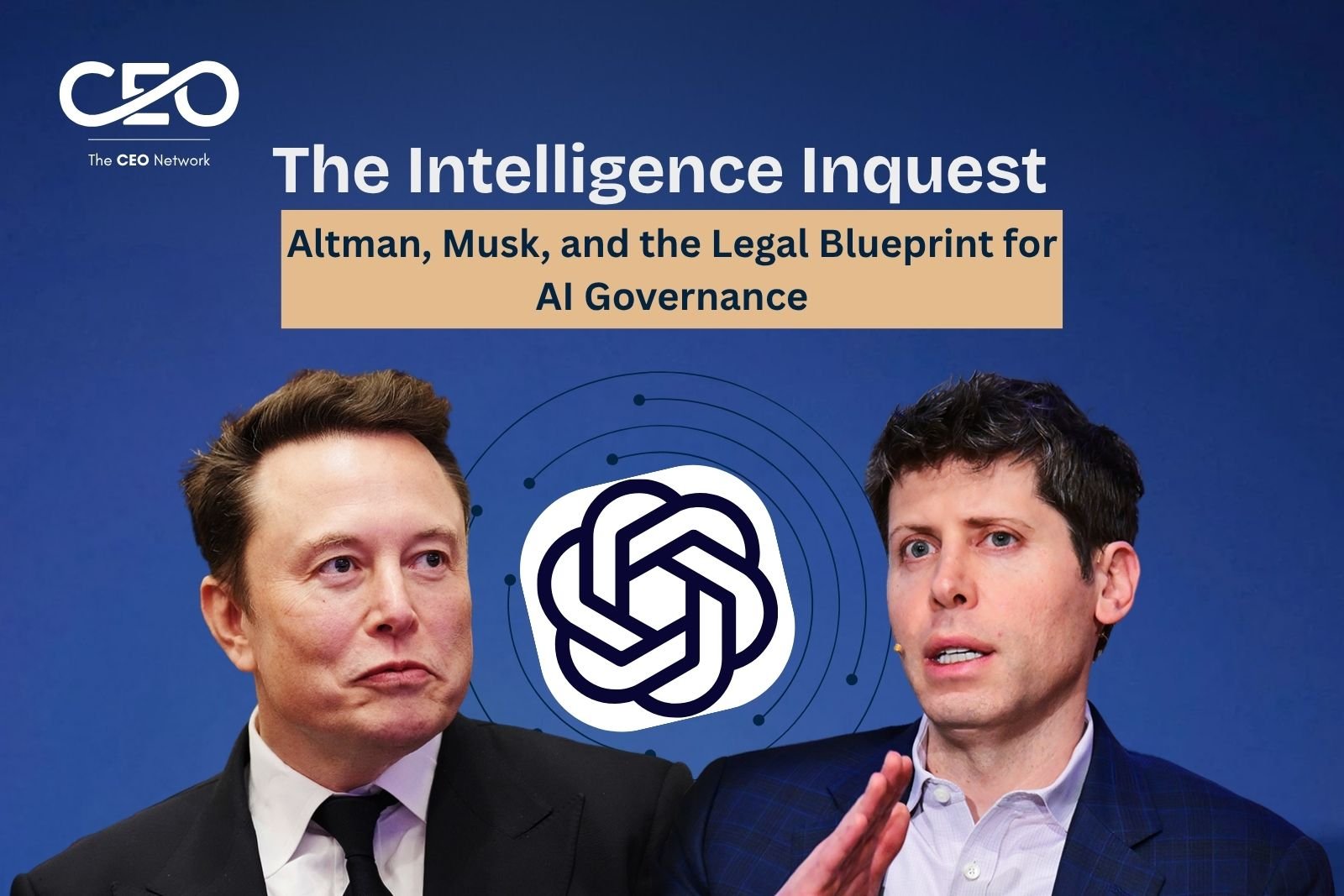
As of May 13, 2026, the global business community is fixated on a federal courthouse in Oakland, California. In what is being hailed as the most consequential corporate trial of the decade, OpenAI CEO Sam Altman took the stand yesterday to defend the organization against a high-stakes lawsuit filed by co-founder Elon Musk.
For members of The CEO Network, this trial represents a watershed moment. It is not merely a dispute between two icons; it is an Intelligence Inquest into the future of “Agentic Business” and how corporate governance must evolve when profit motives collide with humanity-altering technology.
1. The Mission Conflict: Musk vs. Altman
The central tension of the trial focuses on whether OpenAI has strayed from its foundational “nonprofit” roots.
- The Accusation: Elon Musk alleges that Altman and OpenAI breached their original pact by transitioning into a for-profit entity deeply intertwined with Microsoft. Musk is demanding Altman’s removal and a court order to return $134 billion to the nonprofit treasury.
- The Defense: In hours of testimony, Altman argued that the pivot was a strategic necessity to secure the massive capital and computing power required for the development of AGI.
- The Rebuttal: Altman countered Musk’s narrative by testifying that Musk had previously sought “total control” of a for-profit version of the company, suggesting that the current legal battle is as much about personal legacy as it is about ethics.
2. The Microsoft Factor: Governing Global Aligned Interests
The trial also put Microsoft CEO Satya Nadella in the spotlight. His testimony was scrutinized to determine if Microsoft’s multi-billion dollar “partnership” cross-pollinated commercial interests with OpenAI’s mission without sufficient board oversight.
The verdict will have immediate financial ramifications, as OpenAI is currently eyeing a $1 trillion valuation in a projected initial public offering later this year.
3. Operational Innovation: Orbital AI Solutions
While the courtroom battle rages, the physical infrastructure of AI is taking a leap into the atmosphere.
- Google & SpaceX: Insider reports suggest a developing alliance to deploy satellite-based data centers.
- The Energy Pivot: Terrestrial data centers are hitting an “electricity wall.” By placing AI clusters in orbit, firms aim to utilize direct solar energy, effectively bypassing the energy constraints and regulatory hurdles facing Earth-bound projects.
(As CEOs look to power the next generation of data centers, alternative energy sources—from orbital solar to hydrogen fuel cells—are moving from “innovation” to “mission-critical.”)
4. Icons in Transition: Apple and NVIDIA
The broader executive landscape is seeing a generational shift as AI becomes the core of every industrial strategy:
- Apple’s New Guard: Long-time CEO Tim Cook is scheduled to become Executive Chairman on September 1, 2026, handing the CEO reins to John Ternus. Ternus is expected to lead Apple’s aggressive “Edge AI” hardware strategy.
- NVIDIA’s Industrial Call: During his 2026 commencement address at Carnegie Mellon, Jensen Huang declared that we have entered a “new industrial era” where AI is no longer a secondary tool but the primary operating system for all professional sectors.
- Delivery Hero: Co-founder Niklas Östberg has officially begun his succession plan, intending to exit the CEO role by early 2027 to allow for fresh leadership in the hyper-competitive “quick commerce” sector.
The Bottom Line
The headlines of May 2026 demonstrate that governance is the new competitive moat. From the Oakland courtroom to the high-earth orbit of new data centers, the “Agentic” shift requires CEOs who can manage complex partnerships as skillfully as they manage their code.
Is your leadership team prepared for an “Intelligence Inquest,” or is your governance still stuck in the classical era?