











Now Reading: The Constant Running Mind: Sam Altman, Tokenmaxxing, and OpenAI’s Pivotal Bet on Physical Autonomy
-
01
The Constant Running Mind: Sam Altman, Tokenmaxxing, and OpenAI’s Pivotal Bet on Physical Autonomy
The Constant Running Mind: Sam Altman, Tokenmaxxing, and OpenAI’s Pivotal Bet on Physical Autonomy
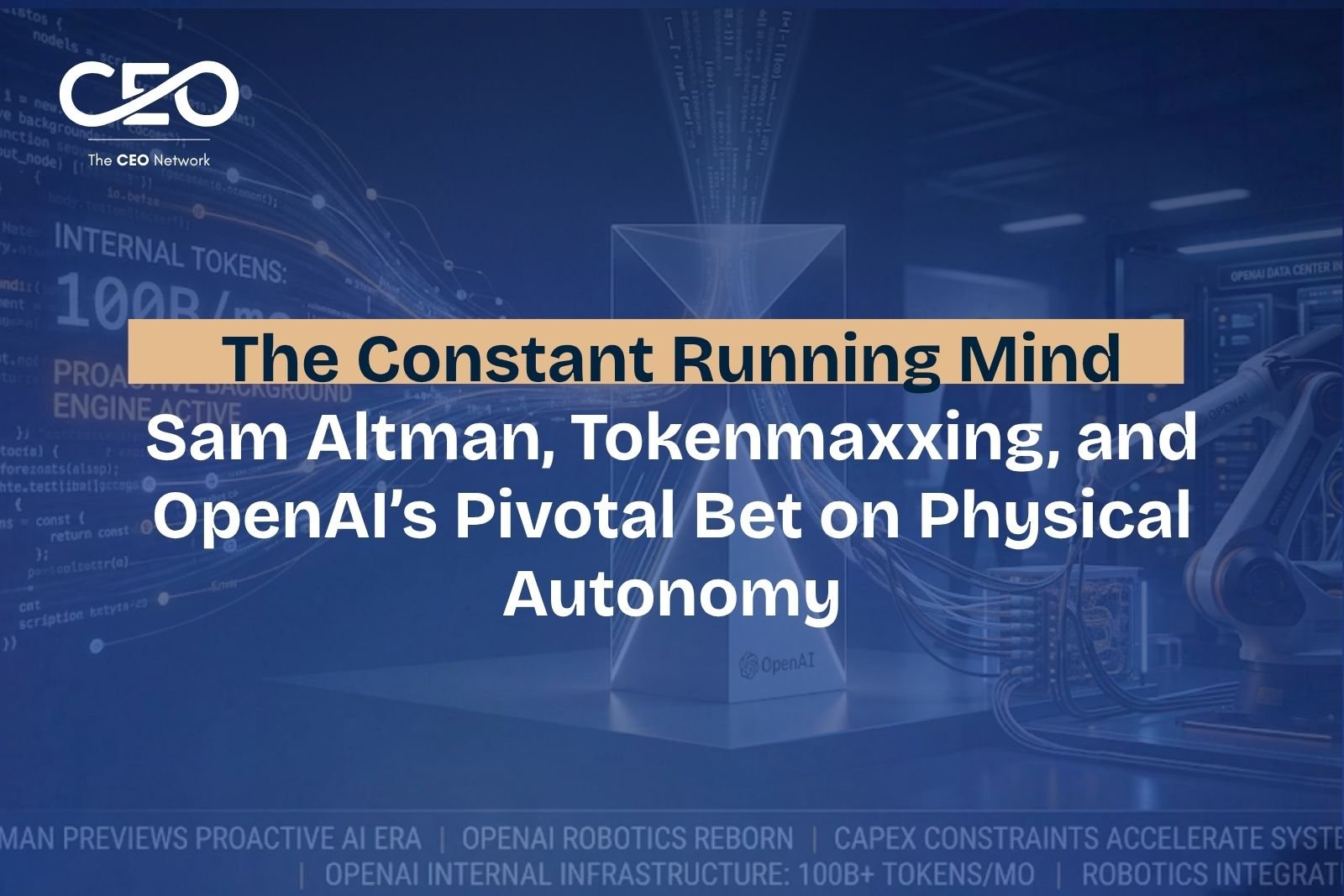
For the global executive ecosystem, monitoring the moves of the world’s chief artificial intelligence architect is standard procedure. Yet, over the last 48 hours, OpenAI CEO Sam Altman has fundamentally altered the corporate playbook. In a series of high-profile disclosures, Altman revealed a dual-track strategy designed to address the two greatest challenges facing modern enterprises: the crushing cost of compute and the physical limits of infrastructure development.
For members of The CEO Network, Altman’s current trajectory signals the end of the “conversational AI” era and the dawn of a far more disruptive epoch: Autonomous World Simulation and Physical Infrastructure Automation.
1. The “Tokenmaxxing” Crisis: When Demand Outstrips Physics
During a live enterprise summit yesterday, Sam Altman dropped a statistic that sent shockwaves through Wall Street and corporate IT departments alike.
- The Staggering Multiplier: OpenAI’s single highest internal token consumer is now burning through a jaw-dropping 100 billion tokens every single month. To understand the exponential scale of this shift, Altman noted that just six years ago, the company’s top user consumed a mere 100,000 tokens monthly. Usage inside the lab has expanded by a factor of one million in less than a decade.
- The “Tokenmaxxing” Culture: This hyper-consumption is fueled by a competitive internal phenomenon known as “tokenmaxxing,” where engineering teams vie on corporate leaderboards to push maximum data volume through models.
- The Revenue Cap: While exciting from a growth perspective, Altman candidly admitted that this surge is exposing a severe bottleneck. Hardware is not scaling fast enough to match the incoming wave of demand, meaning AI providers face a very real physical cap on their near-term revenue growth.
2. The Next Strategic Shift: Proactive, Unprompted AI
To solve the friction of escalating costs—which Altman acknowledged has skyrocketed to the second-most frequent complaint he receives from enterprise clients—OpenAI is altering how its models interact with corporate networks.
Altman previewed the core focus of OpenAI’s software pipeline for the coming year: “constant running proactive AI”.
Instead of operating on a reactive “chat” basis—where an employee must explicitly input a prompt and await a response—future systems will execute continuously in the background. They will autonomously audit enterprise data, optimize supply chains, and balance financial sheets without human intervention. While this model will cause token consumption to explode even further, OpenAI is aggressively re-engineering its pricing tiers to focus on background consumption efficiency to stave off competition from rising rivals like Anthropic.
3. The Physical Pivot: OpenAI Robotics and the Battle with Optimus
Perhaps the most significant pivot of Altman’s 2026 strategy is the formal revival of OpenAI Robotics, marking an explicit entry into physical manufacturing and hardware deployment. The division is built directly upon the foundation of OpenAI’s world-simulation research program.
                 OPENAI'S ROBOTICS INFRASTRUCTURE MAP

  [Software Core]      World Simulation Research (Aditya Ramesh)
        │
        ▼
  [Near-Term Goal]     Robots for Data Center & Power Grid Construction
        │
        ▼
  [Long-Term Vision]   "Personal Robot for Every Citizen"
Altman took to X to announce an aggressive, full-scale hiring blitz for full-stack hardware, operations, and machine learning engineers. This puts Altman on a direct, undeniable collision course with Elon Musk and Tesla’s Optimus program.
However, Altman’s near-term focus is uniquely practical. Rather than trying to build consumer household helpers or generic warehouse workers, OpenAI Robotics is targeting the specialized labor needed to construct data centers, factories, and power grids. Altman is effectively building the autonomous physical workforce required to construct the very infrastructure that his software demands.
The CEO Verdict: Look Beyond the Screen
Sam Altman’s mid-2026 blueprint makes one thing abundantly clear to the C-suite: the era of treating AI as a desktop software novelty is over. As OpenAI transitions into proactive background systems and physical, infrastructure-building hardware, the competitive delta will belong to leaders who integrate these systems into the real world.
Is your firm still treating AI as a tool to write emails, or are you preparing your enterprise for a world of unprompted, proactive background operations and physical automation?