











Now Reading: The Great Cobalt Pivot: How the EV Supply Chain is Being Rewritten by 2028
-
01
The Great Cobalt Pivot: How the EV Supply Chain is Being Rewritten by 2028
The Great Cobalt Pivot: How the EV Supply Chain is Being Rewritten by 2028
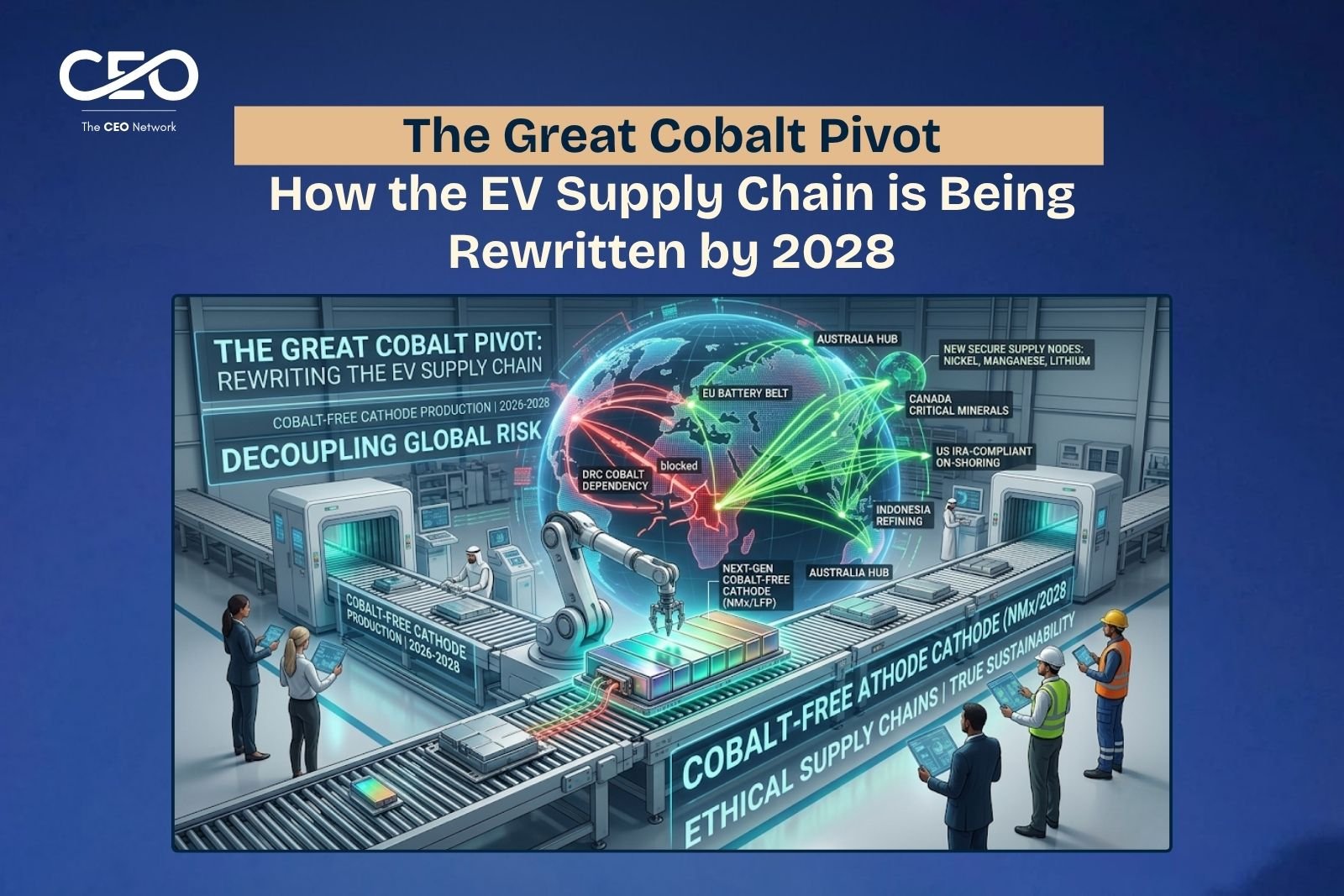
For the past decade, the blueprint for the electric vehicle (EV) revolution was fundamentally flawed. It relied on a fragile, ethically compromised, and geographically concentrated supply chain, with cobalt—the ‘blood diamond’ of batteries—serving as its critical vulnerability. As we accelerate into 2026, the global automotive industry is executing its most significant course correction: “The Great Cobalt Pivot.”
According to new executive analysis finalized in April 2026 by the Global Battery Alliance (GBA), the push for Cobalt-Free Cathodes (CFCs) has shifted from a theoretical goal to an industrial imperative, with profound implications for raw material markets, geopolitical alliances, and corporate sustainability.
For members of The CEO Network, this isn’t just a raw materials update; it is a foundational strategic reset. This pivot is decoupling the future of clean energy from a single, conflict-ridden geographical point, redefining the geography of power in the process.
“The EV industry is realizing that sustainability must begin before the factory floor. Decoupling from cobalt is not optional—it is the prerequisite for scaling to a true zero-emission economy.”
The DRC Dependency and the Ethical Wall
The problem was simple and devastating: approximately 70% of the world’s cobalt is mined in the Democratic Republic of Congo (DRC). While large-scale mining operations exist, a significant portion is ‘artisanal,’ often involving child labor, hazardous conditions, and deep human rights abuses.
For global automakers facing intense ESG (Environmental, Social, and Governance) scrutiny, this dependency became an ethical wall. Leading CEOs, under pressure from consumers and investors, could no longer ignore the human cost of their supply chains. The DRC’s political instability further added immense supply chain risk.
The Breakthrough: The $50 Billion Cobalt-Free Rush
The market response has been unprecedented. Over $50 billion in global R&D and manufacturing investment has been poured into developing and scaling Cobalt-Free Cathodes, primarily focusing on two technologies:
- LFP (Lithium Iron Phosphate): Once considered low-performance, breakthroughs in cell-to-pack technology have made LFP a dominant chemistry for standard-range EVs. It is cobalt-free, nickel-free, and vastly cheaper. Leading players like Tesla and BYD already rely heavily on LFP.
- High-Nickel / Manganese Cathodes (NMC/NMx): For high-performance and long-range vehicles, researchers are successfully minimizing, and in some breakthrough cases in April 2026, eliminating, cobalt while optimizing nickel and manganese content. The challenge remains maintaining structural stability, but the industrial scaling of these next-gen cathodes is now a certainty by 2028.
The New Geopolitical Map: Decoupling and Onshoring
This pivot is fundamentally redrawing the global map of energy storage materials, reducing reliance on not just the DRC, but also on the dominant refiner of cobalt, China.
Key Geopolitical Shifts:
- The Nickel-Manganese Ascent: Countries rich in nickel and manganese—Indonesia, Australia, Brazil, and Canada—are seeing a massive influx of processing investment as they position themselves as the new secure nodes of the EV battery supply chain.
- The Rise of Regional Hubs: The U.S. and the EU are aggressively incentivizing domestic battery manufacturing and critical mineral processing through initiatives like the Inflation Reduction Act (IRA) and the Critical Raw Materials Act. The goal is to build vertically integrated “battery belts” that bypass volatile global bottlenecks.
The CEO’s Battery Playbook: 2026-2030
Wait-and-see is no longer an option. Automotive, energy storage, and electronics CEOs must act proactively.
Immediate CEO Actions:
- Mandate Traceability Audits: By Q3 2026, establish absolute, blockchain-verified traceability for all cobalt still in your supply chain.
- Define a Cobalt-Exit Roadmap: Secure long-term supply agreements for LFP and next-gen cobalt-free chemistries now.
- Invest in Recycling (Urban Mining): The most ethical cobalt is the cobalt that has already been mined. Invest in circular economies that recover critical minerals from end-of-life batteries.
The Bottom Line: True Sustainability or Failure
The approaching post-cobalt era presents both an ethical imperative and a massive strategic opportunity. For visionary leaders, it offers a defining moment. CEOs who successfully execute this pivot will not only secure their enterprise’s future and ESG credentials but will also signal to clients and investors that their organization is built for the long-term, capable of thriving in a truly sustainable, zero-emission world.
Is your organization executing the Great Cobalt Pivot, or are you still anchored to a compromised past?